
Pneumatic cylinders play a central role in industrial machinery by turning compressed air into useful motion. They are found in almost every automated system, from factory assembly lines to packaging plants and automotive workshops. What makes pneumatic technology so popular is its balance of power, safety, and simplicity. Unlike hydraulic systems that use liquids or electrical systems that rely on motors, pneumatic cylinders depend on air, making them clean, fast, and economical to operate.
A pneumatic cylinder consists mainly of a sealed tube, a movable piston, and a piston rod. When air is forced into the chamber, it creates pressure that pushes the piston forward or backward. This movement is transferred to a tool or machine component, allowing work such as lifting, pressing, or sliding. The flow and direction of air are controlled by valves, ensuring smooth and accurate operation.
How Pneumatic Cylinders Are Built
The structure of a pneumatic cylinder is carefully engineered to prevent leaks and handle repeated motion over long periods. The cylinder barrel is usually made from aluminum, steel, or stainless steel for durability. Inside, precision-made seals prevent air from escaping and maintain pressure. The piston rod is often chrome plated or stainless to resist corrosion and wear.
Many models include cushions at the ends of the cylinder to absorb impact when the piston reaches its limit, reducing noise and extending service life. Optional sensors may also be installed to detect piston position, making it easier to integrate the cylinder into automated systems.
Single-Acting Cylinders
Single-acting pneumatic cylinders use compressed air to move the piston in a single direction. A built-in spring or external force returns it. They are commonly used in light-duty work where the motion only needs to go one way, such as opening vents, pushing small items, or activating levers.
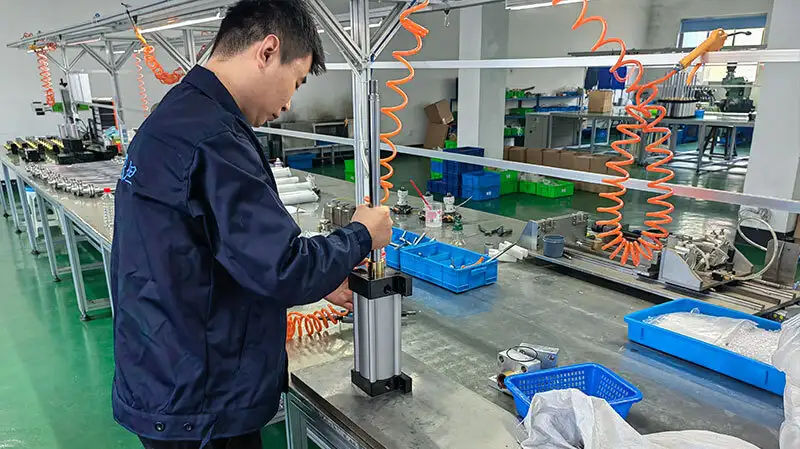
The advantage of this design is lower air consumption and simple installation. However, the return motion depends on the spring, which limits force and stroke length.
Double-Acting Cylinders
Double-acting pneumatic cylinders use air pressure for both extension and retraction. This gives them strong and predictable performance. These cylinders are ideal for production lines that require consistent speed and power. Industries working with heavy parts often rely on this type.
Most pneumatic cylinder suppliers recommend double-acting designs for demanding applications due to their reliability and long operating life.
Compact Cylinders
Compact pneumatic cylinders are designed for tight spaces. Despite their small size, they still deliver sufficient power for everyday automation tasks. They are especially useful in electronics assembly and small-machine automation where space is limited. A skilled pneumatic cylinder manufacturer offers several mounting options for compact cylinders, making them easy to integrate into existing systems.
Rodless Cylinders
Rodless pneumatic cylinders are ideal for long strokes when limited space is available. Instead of extending a rod, a sliding unit on the outside of the cylinder moves the load. This design keeps operations safe and simplifies installation in confined areas. They are frequently used in conveyor systems, doors, and lifting platforms.
Rotary Cylinders
Rotary pneumatic cylinders produce turning motion rather than straight movement. They rotate objects by fixed angles and are used where accuracy is critical, such as in sorting and positioning tasks.
Guided Cylinders
Guided cylinders feature built-in support rods to keep movement stable when loads are uneven. They are ideal in pressing applications and precision machinery.
Working with a Trusted Manufacturer
For consistent performance, choosing a dependable pneumatic cylinder manufacturer is essential. Titan Automation is known for offering high-quality pneumatic solutions tailored to industrial needs. As one of the reliable pneumatic cylinder suppliers, the company provides advanced designs, strict quality control, and dependable service support.
Conclusion
Pneumatic cylinders remain a foundation of modern automation. By understanding their types and functions, businesses can improve efficiency and reduce breakdowns. Choosing experienced pneumatic cylinder suppliers ensures long-term success and operational reliability.